
Full Stack Java Developer Roadmap (2026 Beginner Guide)
In today’s fast-changing tech world, the demand for a Full Stack Java Developer Roadmap is growing rapidly. Companies are not just hiring coders they are hiring problem solvers who can handle both frontend and backend systems with confidence. If you are planning to start your journey in 2026, this roadmap will guide you step by step in a simple, practical, and human way.
What is a Full Stack Java Developer Roadmap?
A Full Stack Java Developer Roadmap is a structured path that helps you learn all the skills required to build complete web applications. It covers frontend technologies, backend development using Java, databases, tools, and deployment.
A full stack developer understands how a user interface works and how data flows behind the scenes. This dual skill makes you highly valuable in the IT industry.
Why is the Full Stack Java Developer Roadmap Important in 2026?
The demand for full stack developers is increasing because companies want professionals who can manage end-to-end development. Instead of hiring multiple specialists, businesses prefer developers who can handle everything efficiently.
In 2026, technologies like cloud computing, AI integration, and scalable systems are becoming standard. Following a proper Full Stack Java Developer Roadmap ensures you stay relevant, competitive, and job-ready.
How to Start the Full Stack Java Developer Roadmap?
Starting the journey may feel overwhelming, but when you break it into steps, it becomes simple and achievable. The key is consistency and practical learning.
Step 1: Learn Core Java Fundamentals
The first step in the Full Stack Java Developer Roadmap is mastering Core Java. This is the foundation of backend development.
You should focus on concepts like variables, data types, loops, OOP principles, collections, and exception handling. Understanding these basics clearly will make advanced topics much easier.
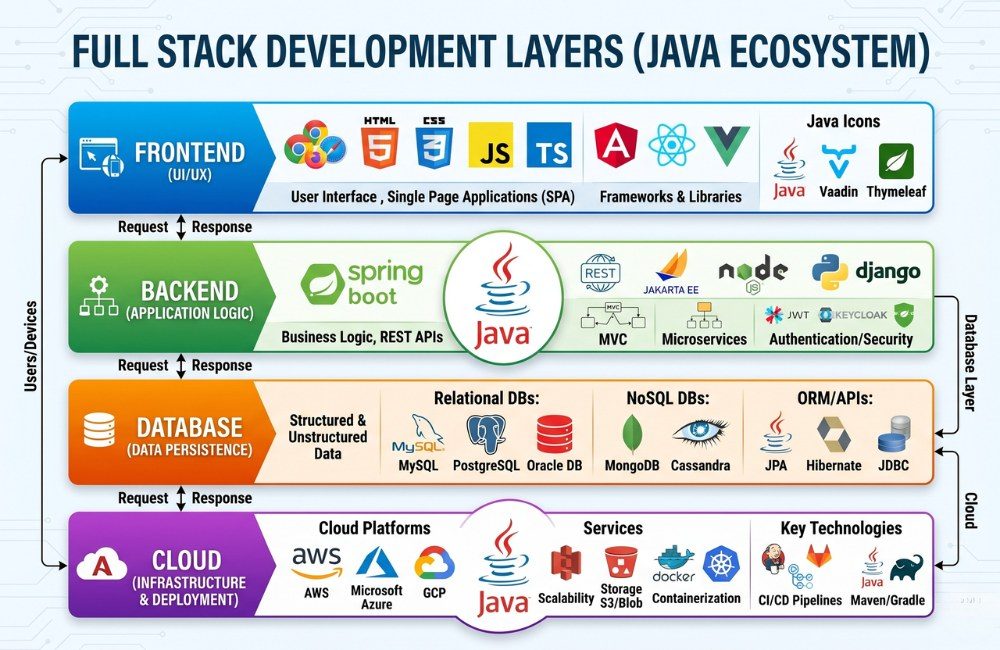
Step 2: Understand Frontend Technologies
A full stack developer must know how to build user-friendly interfaces. Frontend development is where users interact with your application.
Start with HTML for structure, CSS for styling, and JavaScript for functionality. Then move to modern frameworks like React to build dynamic and responsive web applications.
Step 3: Learn Advanced Java & Backend Development
Once you are comfortable with basics, the next step in the Full Stack Java Developer Roadmap is backend development.
Learn frameworks like Spring and Spring Boot. These tools help you build powerful, scalable applications with less effort. You will also learn how to create APIs and manage business logic.
Step 4: Work with Databases
Data is the heart of any application. A full stack developer must know how to store, retrieve, and manage data efficiently.
Start with SQL databases like MySQL. Learn queries, joins, indexing, and database design. Then explore NoSQL databases for modern applications.
Step 5: Learn Version Control & Tools
In real-world projects, teamwork is essential. Tools like Git and GitHub help developers collaborate and manage code effectively.
Understanding version control is a must in the Full Stack Java Developer Roadmap because every company uses it.
Step 6: Understand APIs and Integration
APIs allow different systems to communicate with each other. Learning REST APIs is an important step in becoming a full stack developer.
You should understand how to create APIs, test them, and integrate them into applications.
When Can You Become Job-Ready?
You can become job-ready within 6 to 9 months if you follow the Full Stack Java Developer Roadmap consistently and practice daily.
Focus on building real-time projects like:
- E-commerce applications
- Blog platforms
- Student management systems
Projects prove your skills better than certificates.
Career Opportunities After Following the Roadmap
Once you complete the Full Stack Java Developer Roadmap, multiple career opportunities open up for you.
You can apply for roles like:
- Full Stack Developer
- Java Developer
- Backend Developer
- Web Application Developer
With experience, you can move into senior roles or even become a software architect.
Why Choose APEC Training for Full Stack Java Developer Roadmap?
If you are looking for practical training, APEC Training provides industry-focused programs designed for beginners and professionals.
Their training approach focuses on real-time projects, hands-on learning, and placement assistance. This helps students gain confidence and become job-ready faster.
Conclusion
The Full Stack Java Developer Roadmap is not just about learning technologies it is about building a career. In 2026, companies are looking for developers who can think, build, and innovate.
If you follow this roadmap with consistency and practice, you can successfully enter the IT industry and grow quickly. The journey may take time, but the results are worth it.
FAQ'S
It is a step-by-step guide to learn frontend, backend, databases, and deployment skills.
It usually takes 6 to 9 months with consistent practice.
Yes, Java remains one of the most widely used programming languages in enterprise applications.
No, beginners can start from scratch with proper guidance.
React is highly recommended for modern web development.
Start with simple apps and move to real-time applications.