If there is one topic that defines the conversation around technology today, it is Artificial Intelligence. Almost every industry from banking to entertainment is being reshaped by AI tools that think, create, predict, and automate. Yet among the many terms we hear daily, two of them stand out because of how often they’re used and how easily they’re misunderstood: Generative AI and Predictive AI.
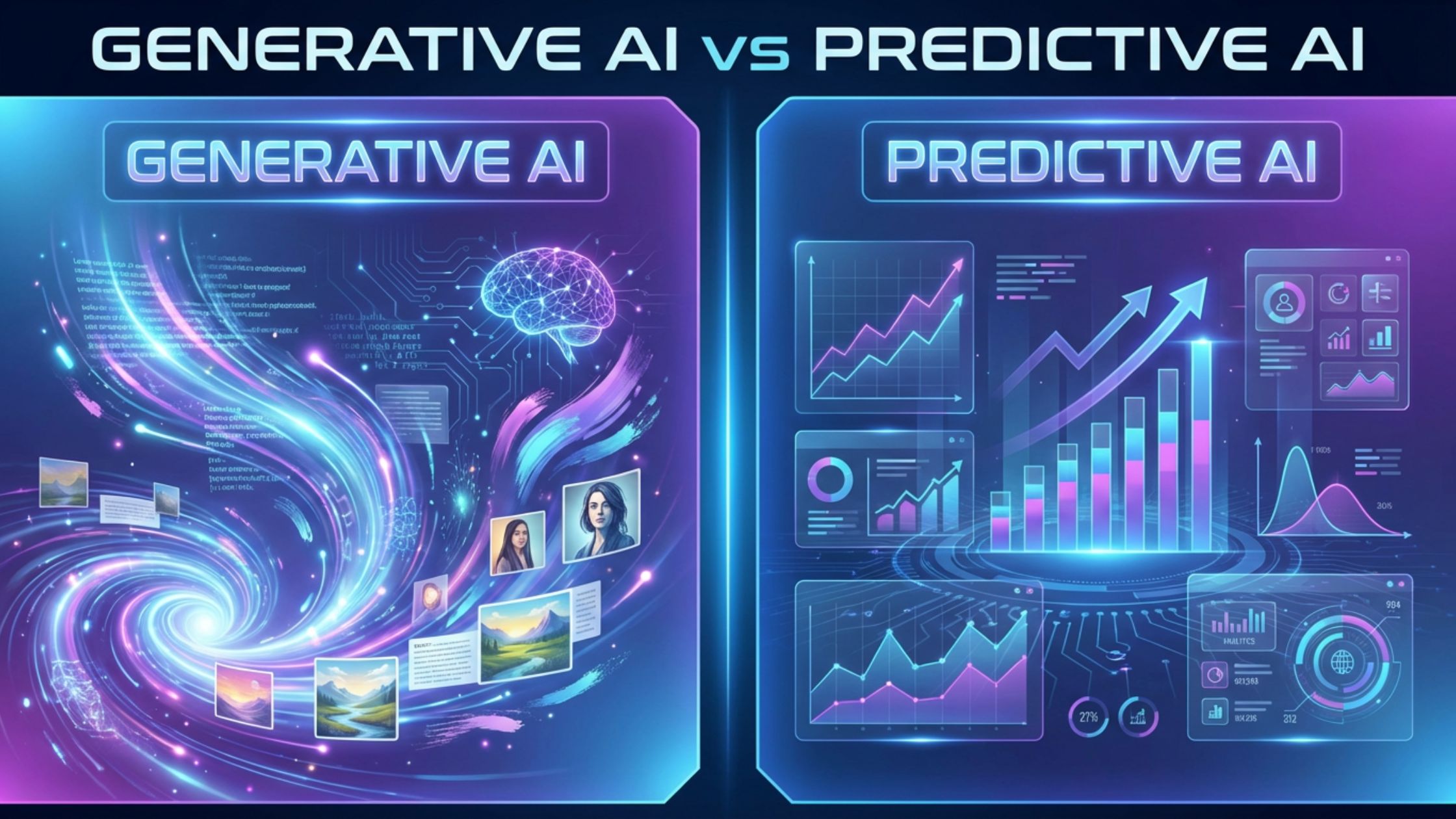
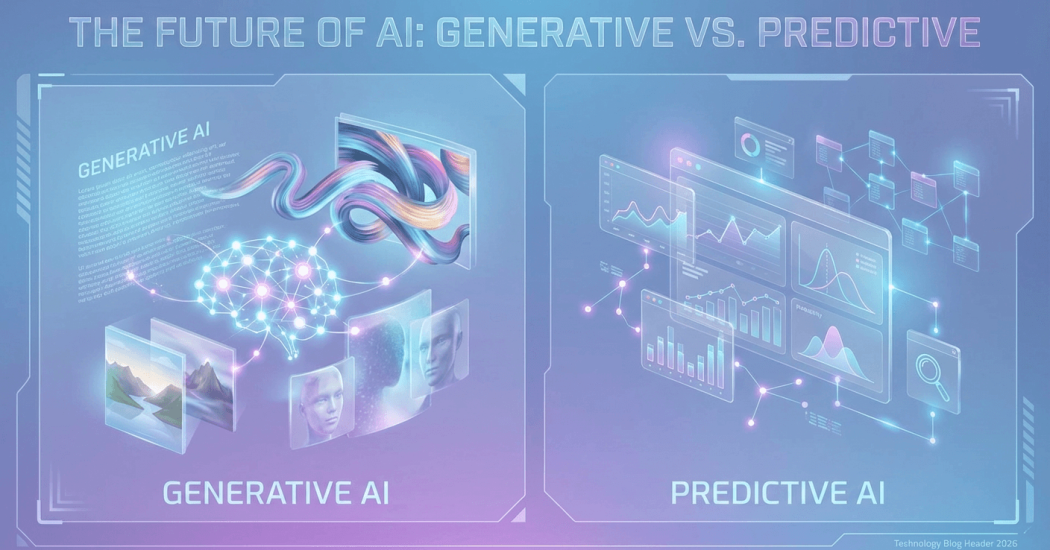
Both technologies sit under the umbrella of AI, but they solve very different problems. One brings creativity to machines. The other gives them foresight. One helps us imagine new ideas. The other helps us understand what might happen next.
As we step into 2026, knowing the difference between these two doesn’t just help you sound smart it helps you stay relevant. Whether you’re a student preparing for your career, a professional exploring growth opportunities, or a business planning your next digital move, this clarity will shape your decisions.
This blog breaks it all down in a simple, friendly, human way without confusing jargon so you can clearly understand what each technology does, why they matter, and how the world is using them today.
What Is Generative AI?
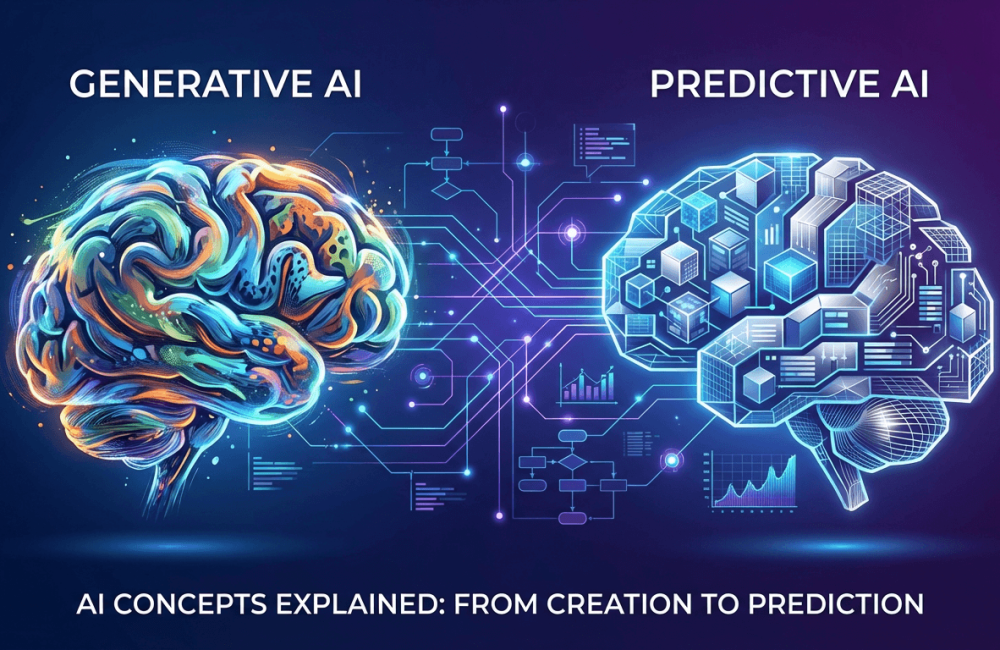
Generative AI is the part of artificial intelligence that allows machines to create something new. That “something” can be almost anything: a paragraph of text, a painting, a video, a voice recording, a song, a presentation, or even a working piece of code.
Instead of just analyzing or sorting data, generative AI tries to answer one simple question:
“Can I make something original using what I’ve learned?”
And surprisingly, the answer is often yes.
How Generative AI Works
Imagine you read thousands of books. Over time, you understand sentence patterns, writing styles, story flows, and how ideas connect. Now, if someone asks you to write a new paragraph, you’re not copying, you’re creating using what you’ve learned.
That’s exactly what generative AI does.
It learns from massive amounts of data, millions of images, documents, recordings, and more and uses that knowledge to create completely new outputs.
What Generative AI Can Create
Generative AI can produce:
- Stories, articles, scripts, emails
- Marketing designs and posters
- Music tracks and sound effects
- Product ideas and prototypes
- Chat responses and training material
- Synthetic datasets for model training
- 3D models, architectural sketches, game designs
- Personalized learning content
The possibilities continue to expand as the models improve.
Where We Use Generative AI in Real Life
If you scroll Instagram, watch product ads, or browse YouTube, you’ve already seen generative AI work without realizing it.
Here are a few everyday examples:
- A company creates 100 ad variations in minutes
- A student asks an AI tutor to explain a concept
- A designer generates logo samples
- A business writes emails automatically
- An app suggests personalized workouts
- A developer gets code suggestions instantly
Generative AI has become the “creative partner” who never gets tired, never runs out of ideas, and never says no to last-minute revisions.
What Is Predictive AI?
If generative AI is about creation, Predictive AI is about anticipation. Its job is not to design posters or write stories; its job is to make smart predictions based on existing data.
Predictive AI tries to answer:
“What is likely to happen next?”
It doesn’t guess randomly. It studies past patterns and uses them to forecast future possibilities.
How Predictive AI Works
Think of a weather forecast. It looks at years of temperature, humidity, and wind patterns to predict rain or sunshine. Predictive AI uses the same logic. It learns from historical data and looks for trends.
If it has seen a pattern many times before, it can confidently say that the same pattern may happen again.
What Predictive AI Can Predict
- Customer buying behaviour
- Drop in sales or rise in demand
- Machine failures in factories
- Loan repayment risk
- Disease likelihood in healthcare
- Fraudulent bank transactions
- Stock movement probabilities
- Student performance trends
Predictive AI doesn’t create new things. It creates insights the kind that businesses depend on every single day.
Where Predictive AI Shows Up in Daily Life
You use predictive AI more often than you think:
- Netflix recommendation lists
- Amazon’s “Customers also bought” suggestions
- Credit card fraud alerts
- Google Maps travel time estimates
- Stock apps predicting market trends
- Fitness apps predicting health patterns
Predictive AI is the “analyst” , the logical, data-driven brain that makes decisions smarter, quicker, and more reliable.
Why the Difference Matters in 2026
Five years ago, these technologies felt new. Today, not understanding them can actually hold you back. The gap between companies that use AI and those that don’t is growing faster than anyone expected.
Here’s why the distinction matters now more than ever:
1. Businesses Need Creativity + Accuracy
2026 is seeing an unusual demand: companies want both creativity and precision. They don’t want content alone. They want content powered by insights. They don’t want predictions alone. They want predictions supported by personalized experiences.
Generative AI handles the creative part, while Predictive AI handles the analytical part. Together, they help businesses launch better campaigns, improve customer satisfaction, and respond faster to market changes.
2. Automation Is Becoming Smarter and More Personal
Brands no longer talk to customers in one tone. Every message is personalized.
Here’s how the two AIs contribute:
- Predictive AI identifies who needs what
- Generative AI creates exactly what they need
This combination is the future of retail, education, healthcare, and entertainment. It’s automation with a personal touch.
3. Decision-Making Has Become Instant
In 2026, companies cannot wait weeks to make decisions. They need answers today, sometimes within minutes.
- Predictive AI helps answer: “Is this a good idea?”
- Generative AI helps answer: “How should we execute it?”
The companies that understand both will always stay faster and smarter.
4. AI Careers Are Growing Faster Than Expected
Whether you are a student or a working professional, knowing the difference between these technologies helps you choose the right learning path.
Popular careers include:
- AI engineer
- Data analyst
- Prompt designer
- AI content developer
- Machine learning engineer
- Business intelligence professional
- Automation specialist
People with skills in both predictive and generative AI will have a major career advantage in 2026 and beyond.
Real-World Examples of Both Technologies Working Together
The most exciting part is not how different they are but how powerful they become when used together.
Example 1: Healthcare
Predictive AI forecasts disease risk
- Generative AI creates personalized treatment plans
Example 2: E-commerce
- Predictive AI analyzes buying behavior
- Generative AI generates personalized product recommendations
Example 3: Education
- Predictive AI identifies weak areas of a student
- Generative AI creates customized study materials
Example 4: Business
- Predictive AI identifies gaps and future trends
- Generative AI prepares reports, designs, or presentations instantly
This combination is shaping the future of nearly every industry.
Conclusion
Generative AI and Predictive AI may sound similar, but they play very different roles in shaping our world. One gives machines the power to create. The other gives them the ability to predict. Together, they are transforming industries, careers, and everyday life in ways we never imagined.
If you want to build a future-proof career and understand how to use these technologies in real work environments, APEC Training is here to guide you